Bubble Honey Jelly: A Sweet Touch for Modern Typography
In the crowded landscape of modern typography, finding a typeface that balances personality with professionalism is a constant challenge. We often see fonts that are beautiful but lack utility, or fonts that are functional but completely devoid of charm. Bubble Honey Jelly enters this space as a distinct solution, offering a handwritten font experience that feels both organic and polished. It is not merely a collection of letters; it is a design asset that brings a specific texture and mood to any canvas. For designers, marketers, and content creators, understanding the nuance of this typeface is key to unlocking its potential.
The Visual Character of Bubble Honey Jelly
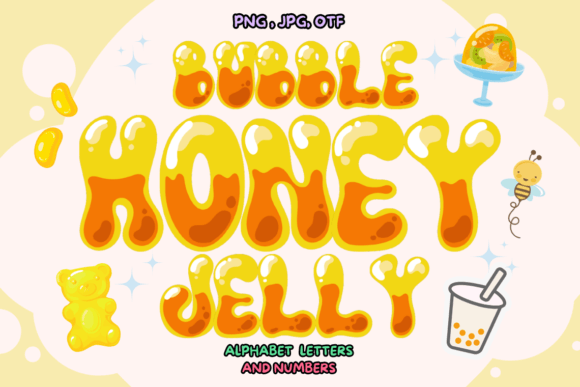
At first glance, Bubble Honey Jelly conveys warmth. The design relies on soft, rounded terminals and a distinct "bubble-like" structure that avoids sharp edges. This creates an approachable aesthetic, mimicking the visual weight and flow of honey or thick jelly. It is a premium font that prioritizes organic shapes, making it an excellent choice for projects that require a human touch without the illegibility often associated with rougher script fonts.
The true distinction of this typeface, however, lies in its implementation as an OpenType-SVG color font. Traditional typography relies on flat, single-color applications. Bubble Honey Jelly leverages modern technology to embed rich, warm hues and gradients directly into the font file. This means the "honey" effect is intrinsic to the letterforms. When you type, you are not just creating words; you are generating complex visual textures that would typically require extensive layering in Adobe Photoshop or Adobe Illustrator. This capability allows for a level of immediacy and consistency in brand identity development that standard fonts cannot match.
Strategic Applications: From Packaging to Digital Media
Choosing the right font is often about context. Bubble Honey Jelly excels in environments where the goal is to attract attention and evoke positive emotion. In packaging design, for instance, this typeface is a natural fit for artisanal goods, confectionery, or organic products. The visual language of the font immediately signals "handmade" and "sweet," aligning the product label with consumer expectations before they even read the copy.
Beyond physical packaging, the utility of this creative font extends heavily into digital realms. For social media graphics, where scroll-stopping power is essential, the color gradient of the font acts as a focal point. It eliminates the need for complex background effects to make text stand out. Similarly, in web design, it can serve as a striking element for hero sections or call-to-action buttons, provided it is used sparingly to maintain load times and readability.
Practical Pairings and Hierarchy
A common pitfall with expressive display fonts is using them for body text. Bubble Honey Jelly is a display font, meaning its strength lies in headlines, logos, and short bursts of text. To build a successful visual hierarchy, you must pair it with a typeface that handles the heavy lifting of long-form reading.
Because Bubble Honey Jelly is rounded and fluid, it pairs exceptionally well with a clean, geometric sans serif font. The stability of a sans serif provides a necessary counterbalance to the playful movement of the jelly letters. Alternatively, pairing it with a classic serif font can create a sophisticated contrast, blending traditional editorial design sensibilities with modern playfulness. The key is to allow Bubble Honey Jelly to dominate the hierarchy for impact, while the secondary font manages the information.
Technical Considerations for Designers
When integrating Bubble Honey Jelly into your workflow, understanding the technical specifications is vital for a smooth process. As an OpenType-SVG font, it contains vector data as well as bitmap data to support the color gradients. This technology is supported by recent versions of major design software, specifically Adobe Photoshop and Adobe Illustrator.
However, compatibility is a crucial factor in project planning. This specific format is not compatible with software that does not support variable color fonts, such as older versions of Inkscape, Cricut Design Space, or Silhouette Studio. If your project involves physical cutting machines, you will need to convert the text to outlines or rasterize the layer in a compatible program first. Always verify that your production pipeline supports OpenType-SVG features before committing to a layout.
Evaluating Fit and Licensing
Before finalizing a design, take the time to test how the font handles specific kerning and tracking. While Bubble Honey Jelly is crafted with professional spacing, the "bubble" nature of the letters can create the illusion of extra space. Adjusting the tracking slightly tighter often yields a more cohesive look for headlines.
Furthermore, as a commercial font, it is essential to ensure your license covers the intended usage. Whether you are a freelance designer creating assets for a client or a small business owner designing your own logo design, the license must align with the distribution method. Most importantly, do not rush the selection process. Print out test sheets or view the typeface at the exact scale of your final output. This ensures that the whimsical charm of Bubble Honey Jelly translates effectively from screen to print, maintaining its visual integrity across all media.